

 立即咨询
立即咨询 载体序列下载
 产品说明书下载
| 产品名称 | pECFP-Mito | 产品货号 | HG-VYC0696 |
| 载体名称 | pECFP-Mito | 出货周期 | 现货 |
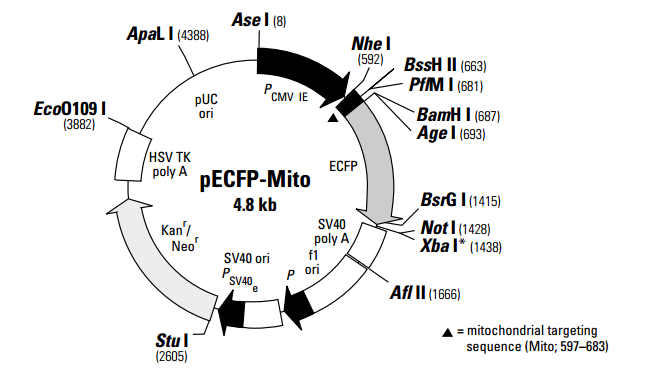
pECFP-Mito encodes a fusion of a mitochondrial targeting sequence derived from the precursor of subunit VIII of human cytochrome C oxidase (1, 2) and the enhanced cyan fluorescent protein (ECFP). The mitochondrial targeting sequence is fused to the N-terminus of ECFP. ECFP is a variant of the Aequorea victoria green fluorescent protein gene (GFP; 3–5) that contains six amino acid substitutions. The Tyr-66 to Trp substitution gives ECFP fluorescence excitation (major peak at 433 nm and a minor peak at 453 nm) and emission (major peak at 475 nm and a minor peak at 501 nm) similar to other cyan emission variants (6–8). The other five substitutions (Phe-64 to Leu; Ser-65 to Thr; Asn-146 to Ile; Met-153 to Thr; and Val-163 to Ala) enhance the brightness and solubility of the protein, primarily due to improved protein-folding properties and efficiency of chromophore formation (7, 9, 10). In addition to the chromophore mutations, ECFP contains >190 silent mutations that create an open reading frame comprised almost entirely of preferred human codons (11). Furthermore, upstream sequences flanking ECFP have been converted to a Kozak consensus translation initiation site (12). These changes increase the translational efficiency of the ECFP-Mito mRNA and consequently the expression of ECFP-Mito in mammalian and plant cells. The vector contains an SV40 origin for replication and a neomycin resistance (Neor) gene for selection (using G418) in eukaryotic cells (13). A bacterial promoter (P) upstream of Neor expresses kanamycin resistance in E. coli. The vector backbone also provides a pUC origin of replication for propagation in E. coli and an f1 origin for single-stranded DNA production.



pSBbi-Pur (Plasmid #60523)

pKS2 (Plasmid #24625)

pET28a-His-TEV-AsCas12a
![pDae079 (eMutaT7[transition])](/uploads/images/202606/6a20df95c8f81.png)
pDae079 (eMutaT7[transition])

pET28a-EGFP-SUMO

pMMB207


